
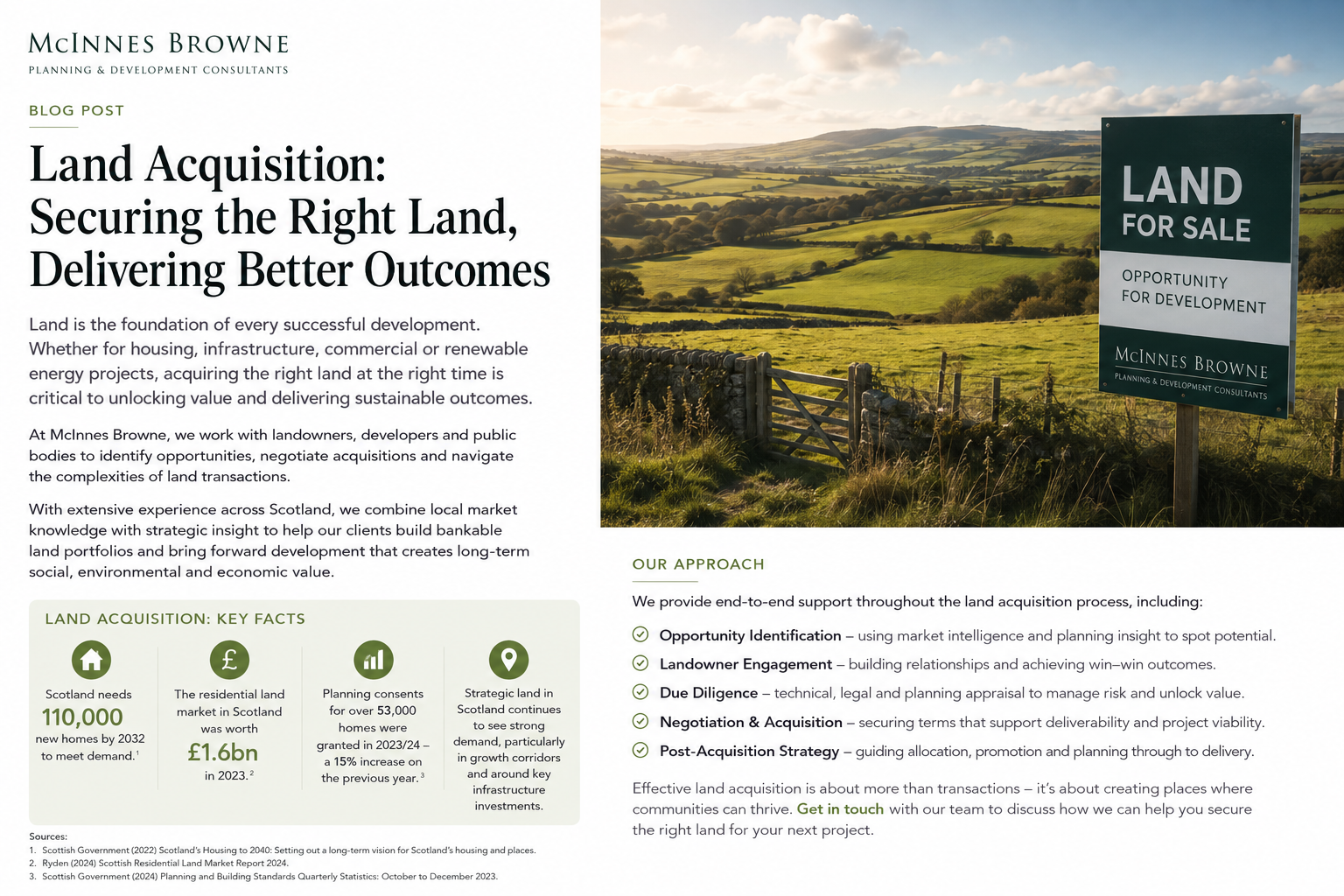
Land Acquisition: Why the Right Land Matters More Than Ever
Land Aquisition
Land sits at the beginning of almost every property development.
Before architects draw plans, before planning applications are submitted and long before construction begins, somebody has to identify a piece of land with the potential to become something more.
That is where land acquisition begins.
At McInnes Browne, we look for land and property with development potential and work with landowners, planning specialists, developers and funding partners to understand what may realistically be achievable.
Sometimes the opportunity is obvious. Often, it isn't.
A paddock beside an existing settlement, an underused commercial site, a redundant building, a large garden or a parcel of land that has been in the same ownership for generations can all potentially have development value — but identifying that potential requires considerably more than simply looking at the size of the site.
England still needs more homes
The underlying demand for new housing remains significant.
Official government statistics show that 208,600 net additional dwellings were delivered in England during 2024–25, including approximately 190,600 new-build homes.
That was actually a 6% reduction from the previous year, when 221,410 net additional homes were recorded. It was also around 16% below the recent peak of 248,590 net additions achieved in 2019–20.
More recent government estimates indicate that approximately 191,300 additional homes were delivered between 1 April 2025 and 15 March 2026.
These figures illustrate an important point: delivering new homes requires a continuing pipeline of suitable land.
Source: Ministry of Housing, Communities and Local Government, Housing supply: net additional dwellings, England: 2024 to 2025.
Source: MHCLG, Housing supply: indicators of new supply, England: October to December 2025.
But not all land is development land
One of the biggest misconceptions surrounding land is that proximity to existing housing automatically means that planning permission should be achievable.
In reality, development potential is determined by a combination of factors.
Planning policy, settlement boundaries, landscape designations, access, highways, ecology, flood risk, heritage, utilities, neighbouring uses and local housing requirements can all materially affect what can be delivered.
That is why our initial assessment of a site begins with the planning context, rather than simply asking how many houses might fit on it.
A smaller site in the right location can sometimes represent a substantially stronger development opportunity than a much larger parcel of poorly located or heavily constrained land.
The five-year land supply matters
National planning policy requires local plans to identify specific, deliverable sites for five years, with an appropriate buffer, together with developable sites or broader locations for growth in subsequent years.
This creates an ongoing requirement for local authorities to understand where future development can realistically take place.
For landowners, that can create opportunity.
Changes in housing requirements, emerging Local Plans, settlement strategies, infrastructure investment and the availability — or shortage — of deliverable development sites can all change the planning prospects of land over time.
Land which may not have represented an obvious development opportunity several years ago can therefore be worth reassessing.
Source: Planning Inspectorate, Local plans: housing land supply evidence (December 2024 Framework).
Finding the opportunity before it becomes obvious
Much of our land acquisition work therefore focuses on identifying potential rather than simply existing planning permission.
We look at questions such as:
- Where is the existing built-up area likely to expand?
- Is the land adjacent to an established settlement?
- What does the Local Plan say about future growth?
- Are there relevant planning applications or appeal decisions nearby?
- Could adjoining ownerships create a stronger development proposition?
- Is there suitable highway access?
- What environmental or planning constraints affect the site?
- Could an alternative use create greater value?
- Would the site appeal to a developer, housebuilder, investor or specialist operator?
Increasingly, data and digital mapping allow these questions to be considered much earlier in the acquisition process.
But data alone does not create a development opportunity. It needs to be combined with planning judgement, commercial viability and an understanding of what potential purchasers and development partners are actually looking for.
Development isn't always about housing
Land acquisition is also about understanding alternative uses.
Depending upon the location and planning context, opportunities might include residential development, specialist housing, care accommodation, commercial property, mixed-use development or other appropriate uses.
Occasionally, the strongest opportunity may also involve combining neighbouring parcels of land.
A standalone field with poor access may have limited potential. Combined with an adjoining property or another landholding, the same site could form part of a much more logical development area.
This is why land assembly can be particularly valuable.
The objective is not simply to acquire more land. It is to create a site that works better from a planning, access, infrastructure and development perspective.
Planning potential can significantly affect land value
There can be a substantial difference between the value of land in its existing use and its value if development becomes achievable.
That potential increase in value — often described as planning uplift — is one of the principal reasons landowners choose to explore their site's development prospects.
However, achieving that uplift can require considerable work and carries risk.
Planning consultants, architects, highways specialists, ecologists, drainage engineers and other professionals may all be required before a planning application can be properly prepared.
For that reason, land transactions are often structured through option agreements, promotion agreements or conditional contracts, rather than an immediate unconditional purchase.
The appropriate structure depends upon the land, the planning strategy and the objectives of the landowner.
A collaborative approach to land acquisition
Good land acquisition should not simply be about obtaining land for the lowest possible price.
The strongest opportunities are generally those where the interests of the landowner and development partner can be aligned.
A landowner may own the asset.
A planning team can establish what might be achievable.
A developer or funding partner can provide the capital and delivery capability.
Our role is often to bring those elements together.
At McInnes Browne, we therefore take a research-led and collaborative approach to land acquisition. We identify potential sites, investigate the planning position, speak directly with landowners and, where an opportunity appears viable, introduce the appropriate planning, development and funding expertise.
Could your land have development potential?
If you own land that sits beside an existing settlement, behind existing housing, forms part of a larger garden or property, or simply appears underused, it may be worth understanding its potential.
That doesn't necessarily mean selling it.
The first step is simply establishing what might realistically be possible.
McInnes Browne welcomes conversations with landowners across Oxfordshire and the surrounding counties, whether the land is already being considered for development or has never previously been assessed.
Sometimes the most interesting development opportunities are the ones that have been hiding in plain sight.
If you own land and would like an initial conversation about its potential, please contact McInnes Browne.
Sources
- Ministry of Housing, Communities and Local Government — Housing supply: net additional dwellings, England: 2024 to 2025. View the official statistics
- Ministry of Housing, Communities and Local Government — Housing supply: indicators of new supply, England: October to December 2025. View the latest housing supply indicators
- Planning Inspectorate — Local plans: housing land supply evidence (December 2024 Framework). View the planning guidance